Cabinet Materials — Philippine Conditions
MDF for Cabinets Philippines: When to Use It & When to Avoid It
MDF is not inherently bad. But in Philippine conditions it is almost always used in the wrong place — as a cabinet carcass in kitchens and bathrooms where it is guaranteed to fail. Here is the honest truth about MDF and where it is and isn't acceptable.
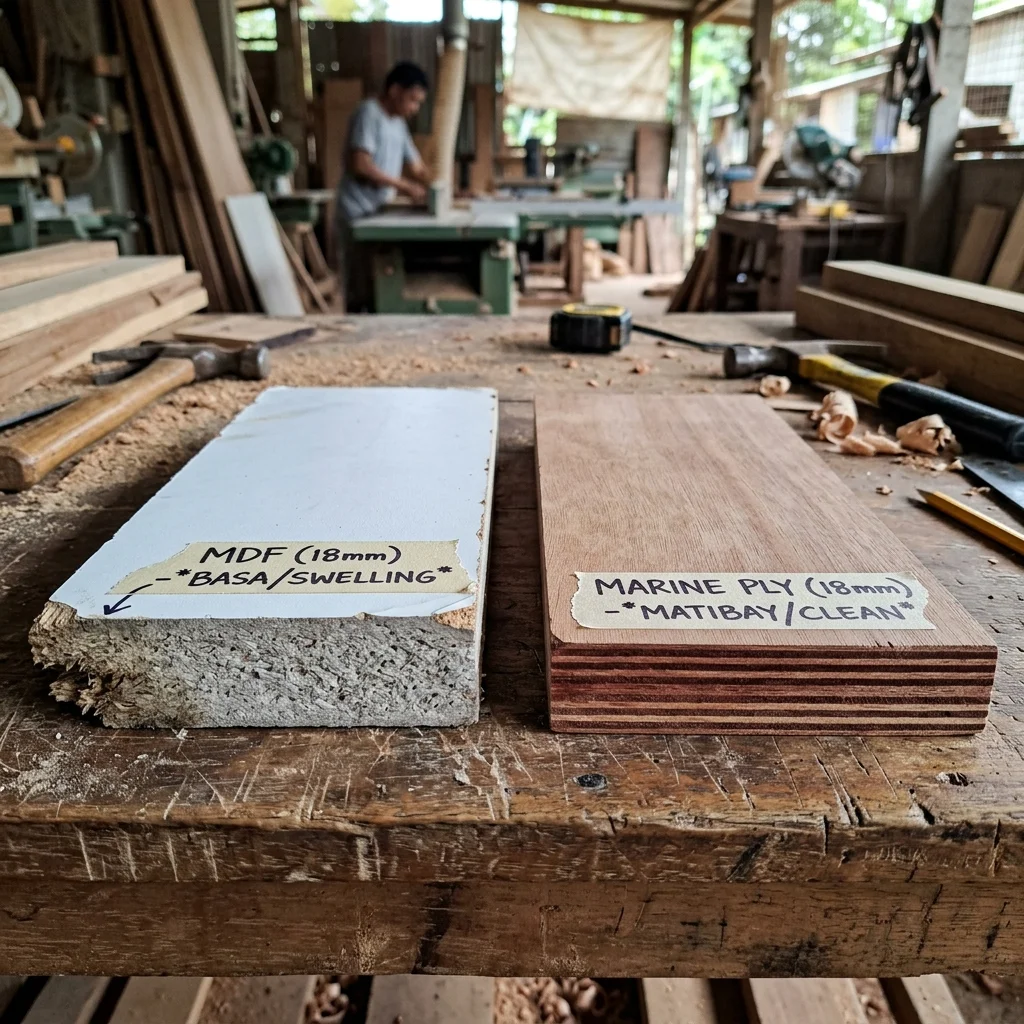
What Is MDF?
MDF (Medium-Density Fiberboard) is an engineered wood product made by breaking down wood fibers and binding them with urea-formaldehyde (UF) resin under heat and pressure. It produces a smooth, consistent surface that machines cleanly for routed edges and flat laminate application.
MDF has legitimate uses in cabinetry. The problem in the Philippines is that it is frequently used in the wrong application — as a kitchen cabinet carcass — where the urea-formaldehyde binder degrades under sustained humidity exposure.
Why MDF Fails in Philippine Kitchens
Urea-formaldehyde resin begins degrading when wood moisture content rises above approximately 12%. At 78% relative humidity (the Philippine national average), MDF equilibrium moisture content is approximately 14–16% — already above the degradation threshold.
In Philippine kitchens specifically, the failure sequence is predictable:
- Year 1–2: Edges and base panels absorb moisture from floor mopping and steam. Internal fiber swelling begins but is not visible.
- Year 2–3: Base cabinet floors show visible upward bowing. Door hinges begin misaligning as carcass deforms.
- Year 3–5: Base panels crack along swollen edges. Hinge screws pull out of swollen substrate. Cabinet doors no longer close correctly.
- Year 5+: Sink area base cabinets fail structurally. Delamination is visible from the sides and bottom panels.
Where MDF Is Acceptable in Philippine Cabinetry
✓ MDF Is Acceptable For:
- Cabinet door panels in dry rooms (bedrooms, living rooms)
- Wardrobe door panels when edges are PVC sealed
- TV cabinet face frames in dry living rooms
- Routed decorative panel inserts (if edge-sealed)
✗ MDF Should Not Be Used For:
- Kitchen cabinet carcasses (any area)
- Bathroom cabinet carcasses
- Laundry area cabinets
- Any cabinet within 1m of a sink or drainage
- Base cabinet floors in any wet-adjacent area
MDF vs HDF for Cabinet Doors
HDF (High-Density Fiberboard) is the better door material for Philippine conditions compared to standard MDF. HDF has a density of 800–1,000 kg/m³ versus MDF's 600–800 kg/m³. The higher density means:
- Better edge integrity when wrapped with HPL or PVC
- Lower moisture absorption rate at the door edges
- Better screw-hold strength at hinge mount points
- Longer lifespan in semi-humid environments (bedrooms with cooking fumes)
For kitchen cabinet doors specifically, HPL-wrapped HDF is the correct specification. MDF kitchen doors wrapped in PVC laminate will show edge lifting within 2–4 years due to steam penetration at the edge banding joint.
Questions
MDF Cabinet FAQ Philippines
Is MDF good for kitchen cabinets in the Philippines?
No. MDF is bonded with urea-formaldehyde resin that degrades above 70% relative humidity. Philippine kitchens average 78% humidity and reach 85–95% during cooking. MDF kitchen carcasses swell, delaminate, and fail within 3–5 years. Marine plywood with WBP phenol-formaldehyde bonding is the correct carcass material for Philippine kitchens.
Can MDF be used for wardrobe cabinet doors?
Yes — MDF is acceptable for wardrobe door panels in dry bedrooms, provided all edges are fully sealed with PVC edge banding (minimum 1mm thickness). MDF wardrobe doors in dry rooms have a lifespan of 8–15 years. They must not be used in bathrooms, kitchens, or any room with regular high humidity.
What's the difference between MDF and HDF?
HDF (High-Density Fiberboard) has a density of 800–1,000 kg/m³ vs MDF's 600–800 kg/m³. HDF has harder surface, better edge integrity, lower moisture absorption, and better screw-hold. For kitchen cabinet doors in Philippine conditions, HPL-wrapped HDF is preferred over HPL-wrapped MDF because HDF resists edge swelling better in humid conditions.
Why do budget cabinet makers use MDF?
MDF costs approximately 20–40% less than marine plywood and machines more smoothly for flat laminate application. Budget makers reduce material costs by using MDF carcasses. The problem: MDF kitchen failures typically appear 3–5 years after installation — after the client has no immediate recourse and often after any warranty period has lapsed.
Build with Marine Plywood — Not MDF
Every CabinetMakerPH carcass is marine plywood. No MDF tier. No substitution after signing.