Cabinet Materials Guide — Philippine Climate Rated
Cabinet Laminates
Everything you need to know about cabinet materials for Philippine conditions — carcass substrates, laminate finishes, edge banding, and hardware. Make an informed decision before you buy.
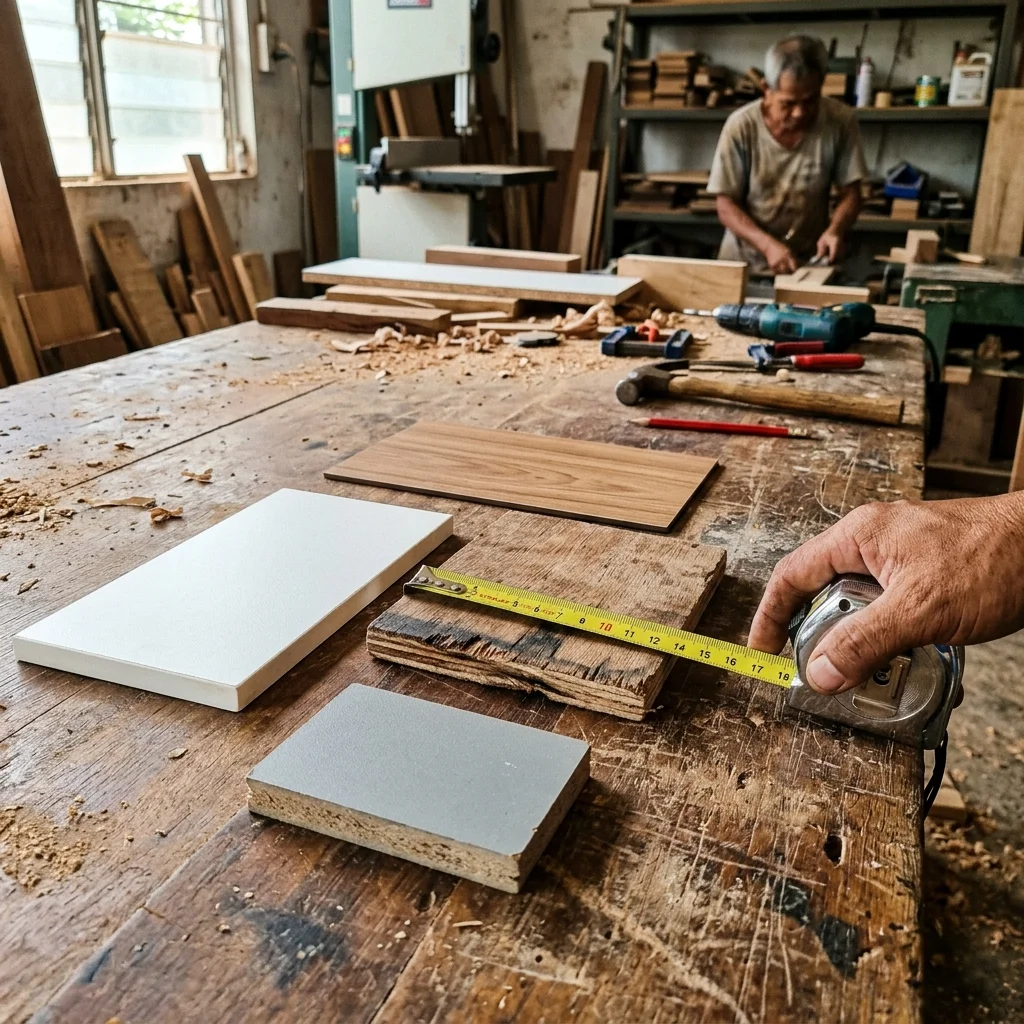
Carcass Substrates
Cabinet Carcass Materials Compared
The carcass (cabinet box) is the structural core. In the Philippines, the wrong carcass material will fail within 3–5 years due to heat and humidity. Here's what you need to know.
Marine Plywood (Recommended)
Marine plywood is bonded with WBP (Weather and Boil Proof) phenol-formaldehyde resin. It is designed to withstand sustained moisture exposure — the same material used in boat building. For Philippine kitchens and bathrooms, where humidity regularly exceeds 80%, marine plywood is the only carcass substrate that performs reliably over 15+ years.
- Bond type: Phenol-formaldehyde (WBP) — does not delaminate under moisture
- Moisture rating: Survives continuous exposure to 95%+ relative humidity
- Screw hold: Excellent — does not strip or swell around fasteners
- Standard thickness: 18mm (carcass), 12mm (back panels)
- Philippine lifespan: 15–25+ years with proper sealing
MDF (Medium-Density Fiberboard)
MDF is widely used in budget cabinetry across the Philippines because it's cheaper than plywood and machines smoothly for laminate application. However, MDF is bonded with urea-formaldehyde resin, which degrades under sustained humidity. In Philippine kitchens, MDF carcasses typically show swelling at the base and around sink areas within 3–5 years.
- Bond type: Urea-formaldehyde — degrades above 70% RH
- Moisture rating: Not suitable for wet areas; swells and delaminates
- Screw hold: Poor when wet — screws pull out of swollen edges
- Standard thickness: 18mm (carcass)
- Philippine lifespan: 3–7 years in kitchens; 7–12 years in dry bedrooms
Particle Board (Chipboard)
Particle board is the lowest-cost option and is used by some budget cabinet makers in the Philippines. It has the worst moisture resistance of all options — it disintegrates when exposed to water and cannot be repaired once swelling begins. We do not use particle board in any of our cabinets.
- Bond type: Urea-formaldehyde (lower quality than MDF)
- Moisture rating: Fails within 1–2 years in wet areas
- Philippine lifespan: 1–4 years; not recommended for any Philippines cabinet
Door Finishes
Cabinet Laminate Finishes Philippines
The laminate is the visible surface of your cabinet. Here are the main options available in the Philippines.
PVC Laminate
Most affordable. Good moisture resistance. Wide color range. Slight edge vulnerability. Best for economy kitchens.
High-Pressure Laminate (HPL)
Scratch and impact resistant. Used in commercial and premium residential. Best for heavy-use kitchens.
Acrylic Sheet
High-gloss mirror finish. Premium look. Fingerprint-prone. Popular in BGC condos and luxury kitchens.
Melamine (Wood Grain)
Pre-bonded wood grain finish. Economy option for bedroom wardrobes. Good print quality, lower moisture resistance.
Hardware Quality
Why Hardware Brand Matters
Cabinet doors and drawers are opened 10–30 times per day. Over 10 years, that's 36,000–110,000 cycles per hinge. Cheap hinges fail at 20,000–30,000 cycles — typically within 3–5 years. Blum and Häfele hinges are rated for 100,000+ cycles with a self-damping mechanism that protects the door from slamming.
We use Blum CLIP top hinges and Blum TANDEM drawer slides as standard on all projects. Blum is the same brand used by IKEA, Scavolini, and European kitchen manufacturers — not because it's expensive, but because it's the most reliable hardware available at its price point.
Discuss Your ProjectBlum / Häfele ✓
- 100,000+ cycle rating
- Integrated soft-close damper
- Adjustable in 3 axes
- Self-repairing clip mechanism
- Used in: CabinetMakerPH
Generic Hinges ✗
- 20,000–30,000 cycle rating
- No damping — doors slam
- Fixed position only
- Screw strip after 3–5 years
- Used in: budget competitors
Materials Questions
Cabinet Materials FAQ Philippines
What is the best material for kitchen cabinets in the Philippines?
Marine plywood (18mm, Grade A, WBP-bonded) is the best carcass material for Philippine kitchens. The Philippines averages 78% relative humidity. MDF absorbs moisture and delaminates within 3–5 years in kitchen environments. Marine plywood does not delaminate under sustained humidity. Read: kitchen cabinet materials guide →
What's the difference between marine plywood and regular plywood?
Marine plywood is bonded with WBP phenol-formaldehyde resin — the same adhesive used in boat building. Regular construction plywood uses urea-formaldehyde resin, which degrades under sustained moisture. Marine plywood also has fewer internal voids, giving it better screw-hold strength. For Philippine cabinet carcasses, marine plywood is the only substrate that performs reliably over 15+ years.
Is MDF acceptable for cabinet doors in the Philippines?
MDF is acceptable for door panels in dry areas (bedroom wardrobes) provided edges are fully sealed with PVC edge banding. MDF doors in kitchens and bathrooms absorb steam and humidity. For kitchen doors, use HPL-wrapped HDF or HPL-wrapped solid MDF with edge-sealed perimeter. CabinetMakerPH uses HPL-wrapped doors as standard for kitchen projects.
What laminate is most popular for kitchen cabinets?
HPL in wood grain or matte solid colors is the most popular finish for standard kitchens in Metro Manila. Acrylic high-gloss is most requested for premium condos in BGC and Makati. PVC laminate is most common for economy and mid-range house-and-lot kitchens. All three finishes are available at CabinetMakerPH.
What hardware brand should be used for cabinet hinges?
Blum and Häfele are the two recommended hardware brands. Blum CLIP top hinges are rated for 100,000 cycles with integrated soft-close damper. Generic hardware store hinges are rated for 20,000–30,000 cycles with no damping — they fail and slam within 3–5 years of daily use. CabinetMakerPH uses Blum as standard on all projects at all price tiers.
Get Cabinets Built to Last
Marine plywood. Blum hardware. PVC edge sealed. Built for Philippine humidity — every single time.